- Rachel Harding
- Compassionate Spirituality, Featured, Rosemarie Freeney Harding, Vincent Harding, Women's Wisdom
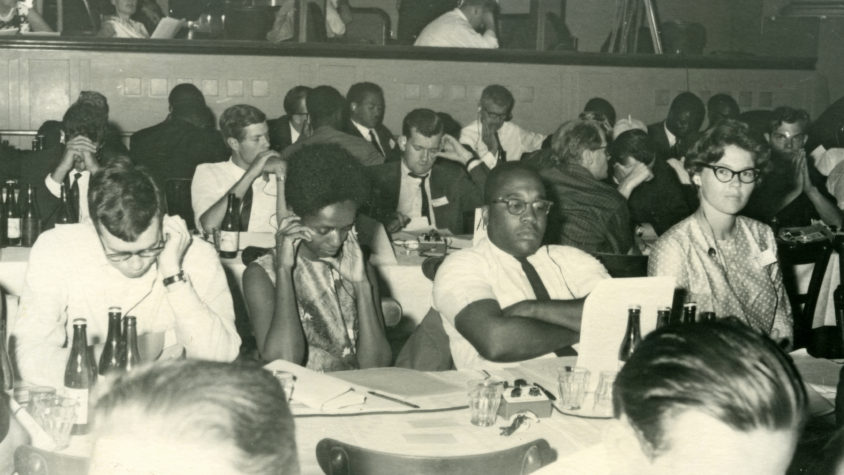
In 1964, Rosemarie and Vincent Harding, spent some time in eastern Europe, traveling for the Mennonite Central Committee, sharing insights on theological and social issues from their experience in the Black Freedom movement in the South (civil rights movement). They participated in meetings and conferences with Christian churches and peace organizations. At the time Mama and Daddy were co-directing the Mennonite House, a residential, voluntary service center based in Atlanta, Georgia that connected young, mostly white Anabaptist, volunteers with movement organizations and community groups. Mennonite House was also an important site for interracial conversation, education, community-building and healing retreat and attracted many students, educators, activists and community members – Black and white – who were working to transform the nation and to explore meanings of racial justice and racial reconciliation in the midst of struggle.
This photo was taken at the 2nd All-Christian Peace Assembly in Prague, Czechoslovakia in summer 1964. I found it on Twitter last night.
And as I looked at the photo, it made me think of something I’d seen very recently.
Back in the late 1990s my mother and I were working on the manuscript that eventually became Remnants. When ideas for stories or chapters would occur to Mama, she would often start telling me about them and I would hurry to get a pen and paper and try to make notes as she reeled off the inspiration that had come to her.
Not long ago, maybe a week or so, I came across a notepad that had some scribblings in my handwriting for a story Mama was developing about the Pachamamas. I can tell by my shorthand descriptions, that I didn’t get it all down. There are big jumps and unfinished places…it was only an outline, in any case. But I can also tell by my writing (and by the nature of the story) that I was excited about what Mama was telling me, and probably responding/reflecting as she talked…so I didn’t catch everything.
But it’s an interesting archival piece and I didn’t want it to get lost. So I have transcribed it here. It’s related to the Pachamamas, a concept that deeply impacted both Mama and me as we were writing her memoir Remnants. The Pachamamas are women-spirits from around the world who embody and enable the life force. The word Pachamama comes from the Quechua language and refers to the powerful, generative, and protective spirits of Mother Earth. If you’ve read Remnants, you’ll recall that I had an extraordinary dream about the Pachamamas just as my mother was first getting very sick. This was before her illness was diagnosed and before I realized how much responsibility I would assume for her care. Our experience with the Pachamamas – starting with the dream and extending into a rich series of stories and Black futurist imaginings – became an important touchstone for us as we worked. But there was much more about our connection to these powerful sacred mothering entities than I could ultimately fit into the final version of the book.
The transcription below, is an effort to share a bit more of what was on Mama’s mind. It is one of several ideas that came to her about how to articulate and share the story of the spirit-women, of all races, from many global places, who quietly, secretly, use their earth-based power to care for each other’s families and to shelter and cultivate profound good in the world.
——
Transcription of notes taken by Rachel Harding, sometime between 1997 and 2002, as Rosemarie Freeney Harding related an idea for a Pachamama story and talked about an experience she had in Czechoslovakia.
This is a story about the meeting of an African American woman and an older woman in the Balkans. The older woman is a member of a secret society, something very ancient, very secret. People fear the power of these women. She is in her late 50s or 60s.
The Black American woman is a journalist and photographer. She was sent by a news agency to get perspective on the violence in the region.
The Black woman grew up in a midwestern city with a large Balkan population. She didn’t know them well. But now, in Europe, she has flashbacks about passing through these white immigrant neighborhoods – Polish, Czech, Slovak, Romanian. Some shops were kind of like botánicas, but more subtle. They had food on one side of the shop, religious articles on the other.
There was a store, near the Black woman’s bus route, where she began to stop more often. They had a small delicatessen counter, like the one in her own grandmother’s store, and she would order a sandwich from among the cured meats and take it with her to her job. The people in the store were usually kind, the Black woman remembers. Whenever she first walked in, they stared at her; but the stares felt familiar. And later when she ate the sandwich, it tasted like her grandmother’s food.
She got accustomed to going there, on her way to work. The people in the store always looked at her, but it wasn’t uncomfortable. It was even a little bit…interested. Maybe even carefully affectionate. And she wondered what they were seeing. Also, sometimes they would be talking and when she entered the shop they would stop – as if not to be impolite.
At the time, the Black woman was a student at Roosevelt University. She finds herself writing about the neighborhoods, the stores, describing the food, the women. Their simple clothes, the easy, firm stoutness of their bodies, the blond hair they wore pulled back in buns or that hung, in shorter cuts, from underneath their head kerchiefs. Their blue eyes.
The white women in the store ask her about herself.
They see something in her related to their people back home. She doesn’t know there are signs. She doesn’t know they are making prayers and offerings on her behalf. And even they do not know what the prayers and rituals will produce.
One day as she enters the store, a young man watches her too. But none of the stares are frightening, stressful or upsetting. Not his. And not the women’s. In fact, the feeling is so mild and comfortable, the Black woman finds herself going into the store even when she is not hungry.
As the story develops we come to find out that she is from the same tradition. Her mother and grandmother, who came up to the city from the South, carried similiar knowings. Wisdoms from the land and in the body. The white women, immigrant women, sensed something.
(Zedecs.)
The young man who watches doesn’t know why he is so attracted to the Black woman. Whenever the other women in the store are talking to her, he finds some reason to come out of the back of the store where he works.
(They knew each other in another life.)
The more they pass glances, the more the Black woman finds she enjoys it.
This, that I’ve just told you is for the story.
What I will tell you now, is my experience. In Czechoslovakia, a woman came up to me and hugged me, held me, and she wouldn’t let go. She hugged me so tight, I almost couldn’t breathe. I had never met her before and she was speaking to me in a language I couldn’t understand. And the people around us, faded back – after a while, in my consciousness, it was just me and this woman. She was holding me and talking to me. And it was as if our connection in that moment was a long-ago family lineage that had forked but that was now circling again, rooting in something the woman recognized. And I just stood there. It was a powerful feeling although I couldn’t understand her words. That actually happened to me when I was traveling, with Vincent in Czechoslovakia.
In another part of the story, back in North America, there is connection to Native American people. There are many connections. Black women’s and Native women’s connections to where we have came from and where our peoples have linked.
Nothing survives but the earth and the mountains.
There will be a gathering of women. The women will be in a slightly mountainous area – a hilly part of the country, like Tennessee or Kentucky. The girl’s ancestors can be from that place.
The women bury secrets of their ceremonies in different places every year. Moving them.
We’ll have Mama Rye burying things in the middle passage.


Leave us a reply