- vohadmin
- #BlackLivesMatter, Compassionate Spirituality, Diaspora, Health and Healing, Rosemarie Freeney Harding, Spirit & Struggle, Vincent Harding, Women's Wisdom
I.
Recently, Rev. Jeri Wright and her father, Rev. Dr. Jeremiah Wright, asked me to join them in leading an early morning prayer fellowship. They have been organizing this informal, online meeting since April, as a service of the Samuel Dewitt Proctor Conference; providing 30 to 45 minutes of grounding and gathering time in the African American Christian, ecumenical tradition on weekday mornings. At each session, different people are invited to share music, prayer and insights in their pastoral roles.
I was happy to be asked to participate and given generous instruction to offer reflection and prayer as I saw fit, from the expanse of my own ritual practices. Rev. Dr. Wright was a friend and colleague of my late father; he and I also share a connection to Afro-Brazilian communities and ritual traditions in Salvador, Bahia. The elder Rev. Wright honored my family by officiating at my daddy’s memorial service in 2014 and I had one of the richest experiences of my teaching career a year or two later, when I taught his students in the Religions of the Black Atlantic Diaspora course at McCormick Theological Seminary. So, needless to say, I felt that I was in a good place, at home, so to speak, in the Proctor Conference morning fellowship, and it was a pleasure to add my few words to the communal fount.
My remarks were essentially a list of insights that have come in recent weeks about how we might, as the poet Lucille Clifton said, “sail through this to that.” I’ve been thinking a lot about my parents, Vincent and Rosemarie. And about my ancestors: my grandparents, my aunts and uncles and cousins who are now on the other side; and the many generations of those who came before us. I’ve been thinking about how they would advise us. How would they encourage us? How would they help us keep our heads high and our spirits strong in the midst of so much trouble and so much assault? I’ve been thinking especially about the Black community in the United States, my people, and our need to re-call, re-member some of the powerful traditions of psychic survival and collective strengthening that our ancestors built for their/our endurance and thriving in this place. And I am thinking of all people as well. Because all of our healing is connected in this nation.
I don’t know how my mother walked her trouble down.
I don’t know how my father stood his ground.
I don’t know how my people survived slavery.
I do remember, that’s why I believe.[1]
II.
It was cold and snowing in Denver on September 9 when I spoke to the Proctor online fellowship. There were, and still are, fires in our state and many more to the west of us in California and Oregon and other parts beyond the Rocky Mountains.
These strange and portentous weather events are, it seems to me, not only a sign of global warming; but they are also a signal to us to be still, and know that God is God. The weather urgencies, the COVID19 pandemic, and ongoing state sponsored violence against Black people – these things combined with the long traumas of our history and the present outrages of an increasingly fascist and fearful administration in Washington – it is all a lot to deal with.
The reflection I offered to the fellowship, came, in a sense, as a combined entreaty from the two primary traditions that I claim as a child of God. That is to say, the African American Christian tradition – especially its mystic and womanist groundings that I inherited from my blood family; and the Afro Brazilian Candomblé tradition, specifically the Terreiro do Cobre community in Salvador, Bahia, which is led by Iyalorixá Valnizia de Ayrá and where I have been a member for almost 30 years.
Both of these traditions honor our connection to God, the great almighty mother and father of the universe. They also teach us to honor our ancestors and the cognizance and strength we inherit from them as children of the diaspora. We recognize the sacredness in all of creation, in all beings; the power of the divine in the natural world around us and in every part of us.
III.
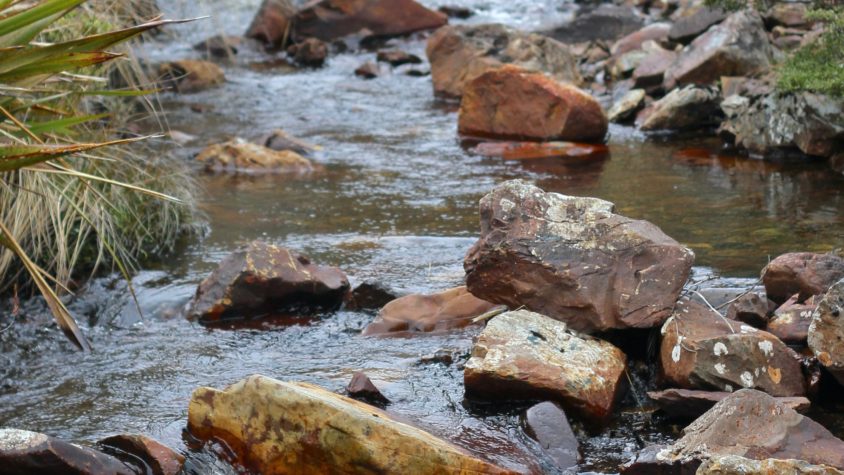
I was at the park near my house a few weeks ago, when the weather was still warm. And there is a stream that runs through the park where I like to go and stand and just be still sometimes. I’m a daughter of water and I get a lot of insight and encouragement from streams and rivers and other bodies of water. So I went to stand and listen to the water. I was there because I wanted to ask God, to ask my ancestors, to ask the natural forces of the universe to help me understand what it was that my people did 70, 100, 150 years ago that helped us survive other terrible times. How did our foremothers and forefathers come through the trials of their days? The lynching times, the massacre times, the slavery times and just the everyday dealing-with-mean-and-crazy-white-folks times.
And as I stood at the water and watched it, meandering slowly, around the banks, a few things came to me. In the live Proctor fellowship, I listed these briefly, and the video recording is attached here for anyone who would like to see and hear the shorter version.
But I want to flesh the ideas out just a bit more; and add a few things I didn’t say in the fellowship service. These are not in any structured order other than the way they occurred to me as I was standing at the stream.
What has helped us. And what will continue to help us:
a. The Collective.
When I asked my ancestors, standing at the water, how did they survive, how did they make it through, the first thing that came to me was: We stayed together. We stayed connected to each other. There is strength in our being together. In standing together. In encouraging one another.
Gathering together is essential to our well-being; to our physical and mental health. In COVID19 times this may be a special challenge, but even sharing fellowship online or on the telephone, serves to help us feel and see and remember our connection to each other. There really is a power, as the Bible says, “where two or three are gathered together in my name…”
If we can do it safely with social distancing, in parks or backyards, or empty lots, or other outside spaces, we should do it. Our smiles, our words of welcome, our elbow daps, our Wakanda hugs, our loud and lyrical laughter, our fervent prayers and our quiet, knowing hmms, are all ways by which we pass strength to each other.
b. Rest.
This is a time when we need our intuition; our inner clarity; and our ability to dream and remember our dreams; because these are resources to help us interpret the way forward. They help us access our direct connection to God. Rest (especially naps and quiet meditative time during the day) helps us so much with this.
Bernice King reminds us that tired does not equal giving up. And Tricia Hersey, founder of the Nap Ministry, teaches us that rest is liberating. Rest is resistance. Rest is our right as human beings. We are not machines and we must rest to revive our bodies, protect our minds and renew our spirits. Rest is also the way spirit speaks to us: in dreams, in insights that come when our minds are unstressed, when we are thinking of “something else” or thinking of nothing at all. Rest is important for our ancestral connections – our ancestors reach us through our intuitions, our discernments and our visions (both waking and sleeping). We need to be rested to receive guidance we can trust.
c. Prayer.
Communicating with our sources of support. Remembering that we are never alone. We are always accompanied by God, and by the ancestors and spirits who love and help us. Prayer and ritual helps strengthen our faith and deepen our awareness of the unbreakable connection we have to God, to the universe, to those who came before us and to the ones who will follow us in this place.
My mother taught me that the earth, the universe, is always caring for us – always supporting and helping us. In this society, we are mostly oblivious to that care, but it is the reason we are alive. It is not a platitude or a simplistic feel-good idea. It is the truth. We are alive because the universe, as an ecosystem (of which human beings are a part) assures the existence and enables the wellbeing of all that lives. We eat because the earth provides food, we drink because the rivers and the ocean provide water, we breathe because the trees and plants clean the air and manufacture oxygen. The ground gives us a place to stand, to build, to live our lives. The chemistry of the earth, as Makota Valdina Pinto often told us, manufactures minerals and medicines that help us stay alive. We are all part of a system of mutual care. It is the way the world works. We are never alone.
One of the women I love and respect most in the world is Valnizia de Ayrá, my mãe de santo (my spiritual mother in the Candomblé tradition). Although Ayrá is her primary orixá, Mãe Val also has a special connection to Iemanjá, the energy of the ocean; and whenever she can, she walks to the ocean to watch the sunrise and spends the early part of the day talking to the Great Mother Iemanjá. Mãe Val says that’s her altar, her prayer and her therapy. Iemanjá is God’s mothering presence in the world; the energy of abundant care, of sharp discernment and good decision-making. I live in Colorado, far from the ocean. But the river and lake waters of the Rocky Mountains are the ocean’s daughters, her sisters, and they give good counsel as well.
d. Dance. Singing. Our music.
Collective Black singing is a power. There is great potency in the African American vocal music tradition. It is not simply a beautiful sound we are making. Our voices are a transformational and protective power. Our songs carry healing energy and our dancing is a direct route to the embodied power of God, the Orixás and the ancestors.
Drum circles and drill teams; second lines; step shows and other gatherings with music and dance where we can move together through our spaces are important to our communal wellbeing. Percussive music and movement does for us what Powwows do for our Native brothers and sisters. It is a way to celebrate and honor our traditions and our connectedness. A way to recognize the importance of the drumbeat (the heartbeat) for us as African descendants, as human beings.
During the Southern Freedom Movement, Black people who were preparing to register to vote or who were organizing to march or demonstrating against the many forms of discrimination enshrined in the laws of the nation, regularly gathered together in what were called “mass meetings” in African American churches to sing and pray and get news and encouragement from one another. The sermons, announcements and exhortations were important but the most vital and effective part of the mass meetings was the singing. People would sing hymns and spirituals, many of which had been given new lyrics and transformed into freedom songs. “Oh Freedom,” “Wade in the Water,” “Guide my Feet While I Run This Race,” “Ain’t Gonna Let Nobody Turn Me ‘Round,” “We Shall Overcome,” and many more. Most of these songs were sung acapella in the tradition of southern rural congregational singing and the power of the voices was phenomenal.
Historian, composer and song-leader Bernice Johnson Reagon was a member of the SNCC Freedom Singers, an activist-quartet that took the songs and stories of the southern freedom movement across the nation in the 1960s. Bernice says that people in the movement used singing as a way to remove fear from spaces they inhabited; as a way to gird up their spirits for the fight; and also as a way to feel connected to each other. Reagon says that when the protestors talked, they “could feel the diversity and complexity” among them, but when they sang, what rose was their connectedness. Music is a way to build and sustain community through crisis.[2]
e. Family.
Our extended families are a great resource and strength in our history. We should do whatever we can with elders, children and everyone in-between together. People of different ages have different perspectives and different skills and we need them all. Our tradition is family. Help each other. Take care of one another. Recognize our relationship with each other. Family is broad, diasporic, ancestral.
In the Afro-Brazilian human rights movement, there is a saying: “Nossos passos vem de longe.” It means, “Our steps started a long way back.” It means, we’ve been walking this road for a long time. It means, our ancestors walked this road before us and we are inheritors of their strength and wisdom. It means we are not new to this work. It means, we have gathered many resources over the course of our struggle – collective, internal, intellectual, cultural, spiritual. We are more ready than we realize for this moment. We are well-accompanied. We do not need to fear but we do need each other and we need to stay connected.
In the traditions of Indigenous African religion, family is also the ancient, ancestral energies in the universe – the natural forces: water, fire, earth, air, mountains, animals, plants, trees. They are the orixás, nkisis, voduns, lwa, wintis and other manifestations of sacred lifeforce in the world. Elders of the Candomblé tradition, like Makota Valdina, teach us that all of those beings whose life enables our life, who were here on the planet before human beings showed up, whose existence intersects with and affirms our own – all of these beings are our family, our ancestors. The forces of the universe are our foremothers and forefathers, and as we gather the family we should remember all our lineages and be thankful.
f. An Ethic of Care.
Extend hospitality and practice generosity with everybody. Black people have an expansive (indigenous) understanding of kin and a tradition of welcoming and feeding/nurturing/caring for whoever comes. This has been important to our survival and it is a great source of healing. We developed this meaning of blackness in the US, but we also brought inclusiveness with us from the West and Central African communities of our origin.
Sunday dinners. Barbeques. Cookouts. The welcome table. Abundant and delicious food is part of the intergenerational spirit of family and community and essential to the way we “love on each other” and express our care for one another. Whenever we can, we should cook and share good meals together. The kitchen is a blessed space, full of good counsel and fellowship.
g. Black Leadership.
The country must honor and embrace the leadership of Black people. Especially the principled leadership of African American women. We must keep our heads and hearts calm through the storms. Be patient with ourselves and each other. And be grateful to God.
IV.
Finally, there are no separate solutions for our nation. If the United States of America is to be a nation at all, we must be a healthy, multiracial nation with room and welcome for everybody who is here. We must create public policies that take care of everyone, because policies that are parsimonious and mean-spirited feed antiblackness in the culture, they feed anti-indigeneity. As a nation, we have to train ourselves out of antiblackness and into beloved community.
Some of these thoughts I have shared are for Black people, in a particular way. And some of this is for anyone who needs encouragement. All of our histories, all of our ancestors, all of our struggles are connected. Let us make repair.
Rachel Elizabeth Harding
October 2020
Denver, Colorado
[1] “I Remember, I Believe,” by Bernice Johnson Reagon. Performed by Sweet Honey in the Rock. [get copyright info]
[2] Bernice Johnson Reagon: The Singing Warrior, Veterans of Hope Project Pamphlet Series 1, No. 1; Veterans of Hope Project, 2000. For a sense of the transformative potential and spiritual force of Black congregational singing in the mass meetings, see Stanley Nelson’s documentary film, “Freedom Summer” especially 1:19:00 to 1:22:15.

Leave us a reply